
Born December 9, 1883 — Died October 9, 1963
There are many stories about where, when, why, and how Joseph Pilates developed the method he called Contrology. Over the years, many of the details have been retold, embellished, or misunderstood. This post is based on research from the Harvard Theatre Collection, Houghton Library, Harvard University, which provides well-documented historical insight into his life, especially the years that shaped his method.
Early Life: Frailty to Strength
Joseph Pilates appeared to be a frail child, reportedly suffering from asthma, rickets, and rheumatic fever. Rather than accepting these limitations, he committed himself to transforming his health and physical ability. His determination led him to become skilled in: gymnastics, diving and skiing.
He studied movement systems from both Western and Eastern traditions, including: martial arts, yoga and bodybuilding. These early explorations seeded the foundations of the method that would later become Contrology.
World War I: The Internment Years (1914–1919)
After the outbreak of World War I, a British Act of Parliament required German-born and Austro-Hungarian–born civilian men living in Britain to be interned to prevent potential espionage. Joseph Pilates was among them.
Newspaper accounts from September 8, 1914 document the arrest of German civilians in Blackpool, England – Joseph Pilates included. He was first taken to Lancaster Camp, which housed approximately 1,800 men and 200 boys. Despite the difficult circumstances, the commandant at Lancaster attempted to improve conditions by providing:
* A boxing ring
* Gymnastics equipment
* Educational opportunities for younger internees
After Lancaster, Joseph was transferred to the Knockaloe Internment Camp on the Isle of Man, in the Irish Sea.
Joseph remained interned for 4½ years, from late summer 1914 until his repatriation to Germany in 1919.
Life and Creativity Inside Knockaloe Camp
Although internment was undeniablyaustere, KnockaloeCamp offered structured activities to reduce boredom and maintain morale:
* Tennis courts
* A football (soccer) field
* Gardens and agricultural plots (which also supplemented food supplies)
* Workshops for building furniture
* Libraries
* Boxing and gymnastics competitions
The living quarters were cramped, cell-like wooden huts where every inch of space was utilized. It is here that Joseph began developing what would eventually become his mat repertoir, working with what he had – little more than his body and gravity.
Joseph later said he was “very glad” for the time he spent at Knockaloe, as it gave him the freedom and necessity to develop, refine, and test his method, helping sick and depressed fellow internees regain strength and hope. He is said to have created hundreds of exercises, laying the foundation for Contrology, and ultimately, the Pilates we practice today.
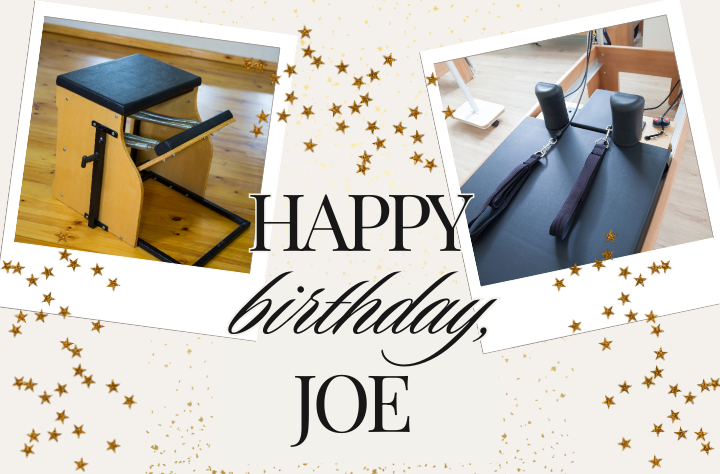
It is also from this period that he began conceptualizing equipment-based resistance training. His later inventions – the Reformer, Cadillac, and Wunda Chair – trace their origins to the improvised apparatuses he designed in camp using beds, springs, straps, and supports.
After the War: Emigration and the Birth of Contrology in America
In December 1926, Joseph Pilates emigrated to the United States, settling in New York City. He opened a studio with his wife, Clara, and began teaching what he called Contrology.
His studio emphasized:
* Breathing
* Proper posture
* Control of movement through concentration and precision
* Smooth, gliding motion of the equipment
* Fluid, integrated movement from simple to advanced exercises
Joseph believed that physical fitness was not simply exercise, it was a way to improve every facet of one’s life.
He went on to receive more than 20 patents for exercise and rehabilitation equipment. His machines, including the Reformer, Cadillac, and Wunda Chair, reflected his unique ability to blend engineering, anatomy, and movement science, skills honed during his camp years.
Sentirsi’s Commitment
At Sentirsi Pilates, we honor Joseph Pilates’ legacy by encouraging the body to move efficiently, fluidly, and with intention through every exercise, whether simple or complex.
We believe, as Joseph did, that Pilates is not just a workout.It is a method to improve your life – physically, mentally, and functionally.